 Queenstown City Guide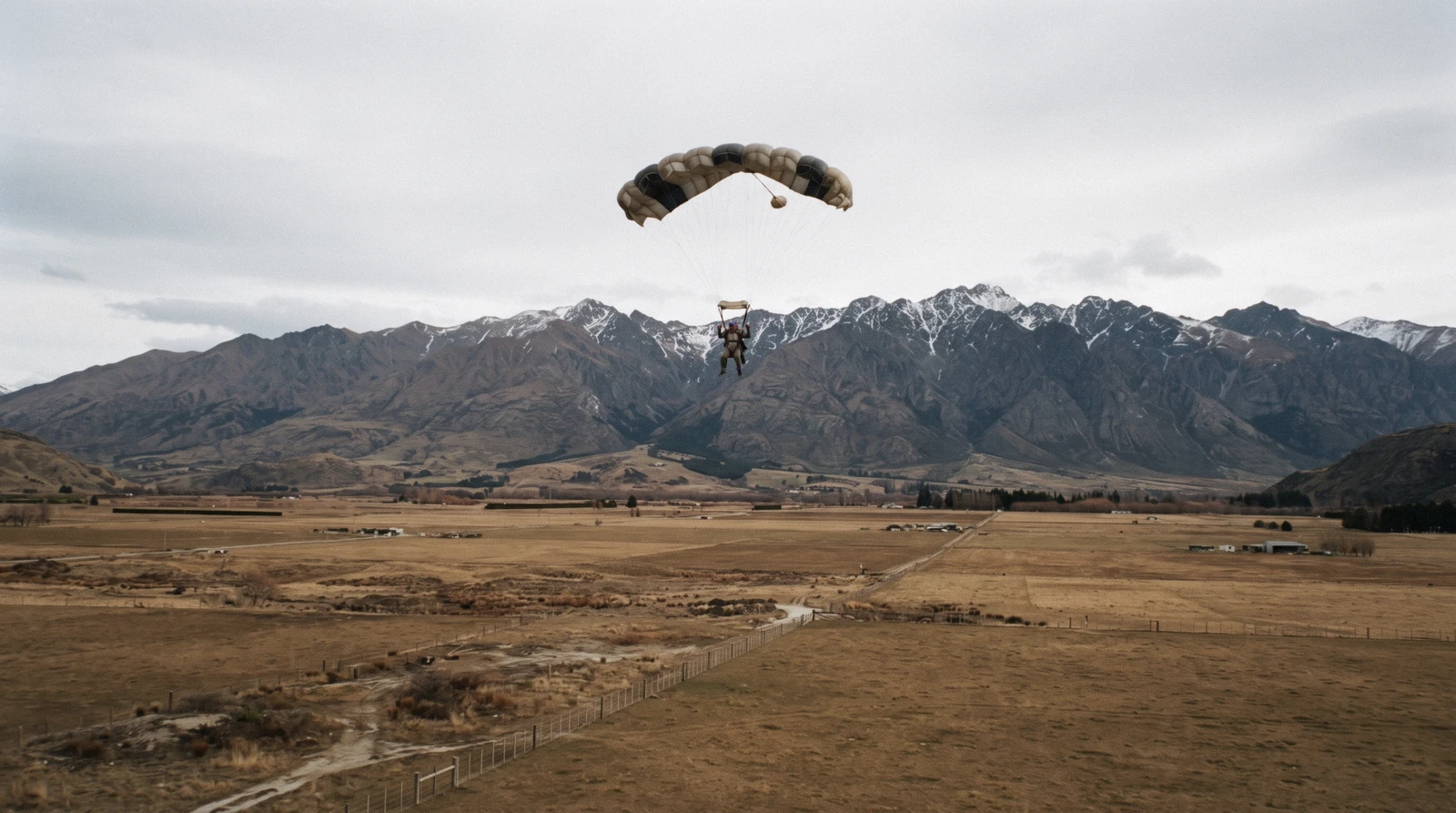
Skydiving in Queenstown, New Zealand
There is one drop zone for skydiving; Queenstown's sits on a working sheep farm, and the booking is sold as a single decision, which altitude, when it is really three: the altitude, the media package and the weather. NZONE Skydive is the operator, its drop zone is a private airstrip on a working sheep farm at the base of The Remarkables, and its own price list makes the arithmetic uncomfortable once you add footage. This page prints all of it, including the rule that stops you filming the jump yourself, and sits inside the adventure activities hub alongside every other way of leaving the ground in this town. Every other way to leave the ground here is indexed on the Queenstown guide homepage.
Quick answer What each altitude costs, what the footage adds, and what happens if the weather turns
One operator runs tandem skydiving in Queenstown and it sells three altitudes out of the same aircraft: 9,000 ft at $209.70 (NZ$359), 12,000 ft at $262.20 (NZ$449) and 15,000 ft at $320.60 (NZ$549). Prices on this site are in US dollars first with the New Zealand dollar in brackets, converted at NZ$1 = $0.584. What the extra money buys is freefall seconds and nothing else: up to 25 at 9,000 ft, up to 45 at 12,000 and up to 60 at 15,000.
Key takeaways
- The middle altitude is the one we would book. It nearly doubles the freefall for $52.50 (NZ$90) over the entry jump, while the top step adds another 15 seconds for a further $58.40 (NZ$100), and the altitude table sets the three side by side.
- You cannot film it yourself. No GoPro, no smart glasses, no phone in the aircraft, which is why the media package can cost as much as the jump and why that decision belongs on the booking screen rather than at check-in.
- The platform listing for the tandem skydive prints a photo and video package inside its inclusions, which the operator's own price list sells separately, so read the inclusions at the date step before assuming either way.
- Weather scrubs jumps often enough that the operator tells you to book the first slot of your trip and keep a spare day. What it does when that happens is stated in its own words, and the seasons page has the wider picture.
Key facts
Opening hours
| Year-round, seven days a week | The operator publishes no opening or closing time. It states that it operates seven days a week and through the day, and allocates jump times at booking |
|---|---|
| Flight to altitude, 15,000 ft | About 15 minutes, per the operator's own FAQ |
| Check-in to return | About 3.5 hours, weather and air traffic permitting |
Closed None published. The operator names no closed day; weather, not the calendar, is what stops a jump
Admission
- Adult
- 9,000 ft from $209.70 (NZ$359), 12,000 ft from $262.20 (NZ$449), 15,000 ft from $320.60 (NZ$549)
- Reduced
- No child fare is published. Children from age 6 jump at the adult price, and jumpers of 12 and under are limited to 9,000 ft. Under-18s need written parental consent
- Free
- Spectators ride the bus to the drop zone free when there is room, one per customer, and never on the last trip of the day
Planning it
- Time needed
- About 3.5 hours from check-in to being back in town, of which under a minute is freefall
- Book ahead
- Recommended — a few days
- Address
- Check-in at the NZONE Skydive Centre, 35 Shotover Street, Queenstown. The drop zone is a private airstrip about 20 minutes away at the base of The Remarkables, and transport both ways is in the price
Two ways to book the same aircraft, priced from nzoneskydive.co.nz and from the platform listing on in Q3 2026. The operator's own row is first and its link carries no tracking. US dollar figures are converted at NZ$1 = $0.584, and the operator states its prices are in New Zealand dollars.
The altitude is the cheap decision. The footage is the expensive one, and nobody tells you that until check-in.
| How you book | Price | Freefall | What it settles | Book |
|---|---|---|---|---|
| NZONE Skydive, booked directAnyone who wants to choose the altitude on the day, or who is likely to move the booking for weather and wants the operator handling it directly | From $209.70 (NZ$359) to $320.60 (NZ$549) | 25 to 60 seconds by altitude | All three altitudes on one screen, the operator's own weather terms, and photo or video added at check-in | Official site |
| Tandem skydive on the platform listingFirst-time jumpers who want a cancellation window written into the booking and a single price with the media question already answered | $210.13 | 30 to 60 seconds on the listing's own wording | Free cancellation up to 24 hours ahead, a fixed start time, and a photo and video package named in the inclusions | Check Availability |
There is no third row to add. Queenstown has one commercial tandem drop zone and the same company runs the Wanaka operation; a listing that sells a Queenstown skydive is selling a seat in this aircraft. Indoor skydiving, which the related searches ask about repeatedly, does not exist in Queenstown at all.
Tandem Skydiving in Queenstown: the Bookable Listing
One card, because there is one commercial drop zone. The price is the platform listing in US dollars read on in Q3 2026, and the card links through to the operator's live calendar where the altitudes and the day's availability sit.
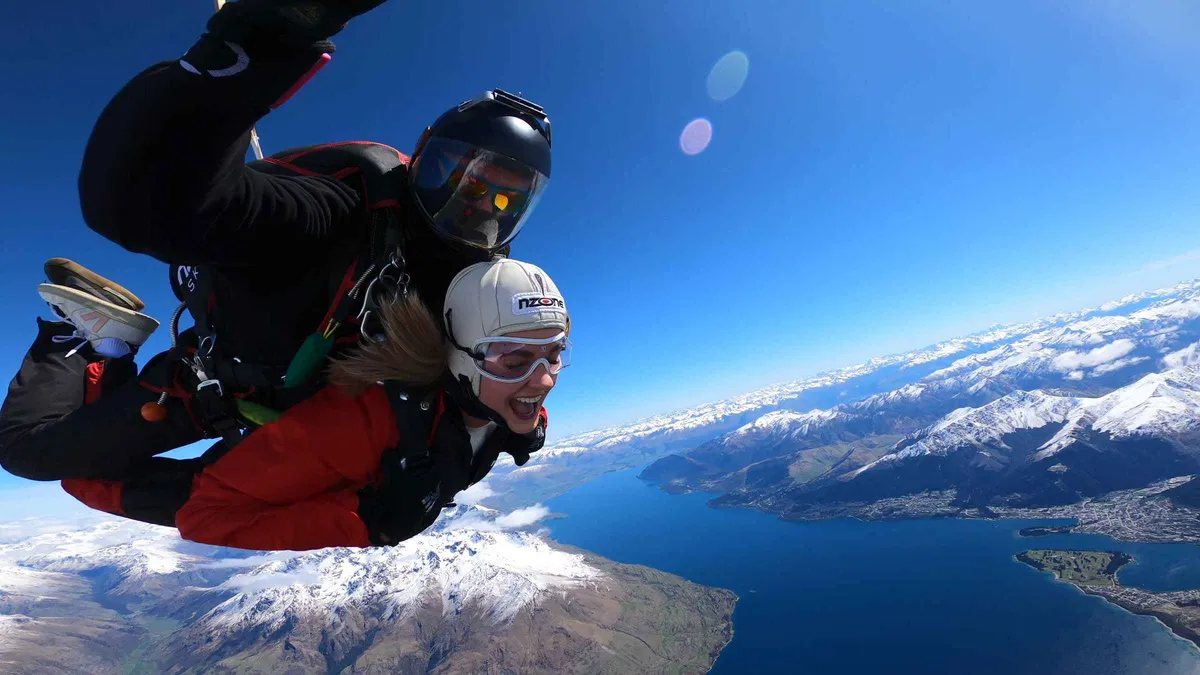 from $210.13
Queenstown: Tandem Skydive Experience
Three altitude options, 9,000, 12,000 or 15,000 feet, from the drop zone over the Wakatipu Basin. Allow three hours on the ground: the freefall lasts under a minute and the canopy ride about five.
Check AvailabilityPrefer to deal with the operator? The untracked link in the table above goes to the same aircraft and the same tandem masters.
Prices, ratings and details are the platform's own, checked in Q3 2026; dollar figures are the listed prices — the platform bills in your account's currency.
Which Altitude to Book, and What the Extra Money Buys
Three prices, one aeroplane, one drop zone. The only variable between them is how long the aircraft climbs before the door opens, and the figures below are the operator's own, read on in Q3 2026.
The pitch for the 15,000 ft jump is a full minute of freefall. That is true and it is worth understanding what it costs per second. Going from 9,000 to 12,000 ft adds 20 seconds of freefall for $52.50 (NZ$90). Going from 12,000 to 15,000 adds 15 seconds for $58.40 (NZ$100). The first step is better value than the second, and it is the step that changes the experience most: 25 seconds is over before the brain finishes arguing with itself, 45 is long enough to stop panicking and look at the Wakatipu Basin.
Everything else is identical. The same Cessna Grand Caravan, the same tandem masters, the same three to four minutes under the canopy, the same 200 km/h in the fall. Nobody is sold a better view at 15,000 ft, only a longer look at it.
| Altitude | Price | Freefall | Climb to altitude | Who it is for |
|---|---|---|---|---|
| 9,000 ft | $209.70 (NZ$359) | Up to 25 seconds | Shorter than the 15 to 20 minutes quoted for the top jump | Jumpers of 12 and under, who cannot legally go higher, and anyone treating this as a tick rather than a memory |
| 12,000 ft | $262.20 (NZ$449) | Up to 45 seconds | Most of the 15 to 20 minute climb | The default. Nearly double the freefall of the entry jump for the smaller of the two price steps |
| 15,000 ft | $320.60 (NZ$549) | Up to 60 seconds | About 15 minutes | People who will not be back, and who would rather buy the extra 15 seconds than the video |
The canopy ride is the same length whatever you pay
Three to four minutes under the parachute, on every jump. That is the part most people remember afterwards, because it is the only part slow enough to look at anything, and it does not scale with the ticket. If the budget forces a choice between altitude and footage, the thing you are cutting from the 9,000 ft jump is 20 seconds of the loudest, least memorable phase of the day.
The operator also puts a hard rule around children: from age 6, and 12 and under are limited to 9,000 ft. That is not a recommendation, it is the ceiling. Queenstown with kids has the rest of the age minimums in this town on one page.
The Camera Ban, and Why the Footage Costs What It Does
The single most expensive rule in Queenstown adventure tourism is one sentence on the operator's FAQ page, and almost nobody reads it before booking.
You cannot take a camera on the jump. Not a GoPro, not smart glasses, not a phone, not anything that records. The operator states it as a New Zealand Parachute Industry Association safety procedure and requirement, not as an upsell, and it applies to every jumper. You can photograph on the ground beforehand and that is the extent of it.
Which means the only footage that exists is the operator's, and it is priced accordingly: $122.10 (NZ$209) for the handicam package shot from the tandem master's wrist, $186.30 (NZ$319) for a dedicated camera flyer who exits the aircraft alongside you, and $221.30 (NZ$379) for both. The freefall cameraman and the combination cannot be pre-booked at all; they are day-of purchases, subject to availability, added at check-in when you are already committed.
| Jump | Jump only | With handicam | With camera flyer | With both |
|---|---|---|---|---|
| 9,000 ft | $209.70 (NZ$359) | $331.70 (NZ$568) | $396.00 (NZ$678) | $431.00 (NZ$738) |
| 12,000 ft | $262.20 (NZ$449) | $384.30 (NZ$658) | $448.50 (NZ$768) | $483.60 (NZ$828) |
| 15,000 ft | $320.60 (NZ$549) | $442.70 (NZ$758) | $506.90 (NZ$868) | $542.00 (NZ$928) |
The line where the media costs more than the jump
It crosses at 9,000 ft. The handicam at $122.10 (NZ$209) is a little over half the entry jump; the camera flyer at $186.30 (NZ$319) is most of it; both together at $221.30 (NZ$379) cost more than the jump itself. A 9,000 ft jump with the full media package comes to $431.00 (NZ$738), which is more than a 15,000 ft jump with nothing.
That is the arithmetic worth doing before check-in rather than at it. If footage matters more than seconds, buy the entry jump and the handicam and stop there, $331.70 (NZ$568). If the fall matters more than the file, buy 12,000 ft and nothing, $262.20 (NZ$449). What you should not do is walk in undecided and let the desk sequence the decision for you.
The one price that is not the operator's
The platform listing at $210.13 names a photo and video package among its inclusions, which the operator's own price list treats as a separate purchase. We have not been able to reconcile the two from published pages, and we are not going to guess: read the inclusions on the listing itself at the date step, where the altitude and any media are selected, and take that wording as the contract.
One more line on money. The operator adds a 1.2% card surcharge on non New Zealand debit cards used at the drop zone or over the phone. It is small, it is non-refundable, and it applies exactly where you are most likely to be adding a media package on the spot. Queenstown costs covers the rest of the card and cash questions.
Three and a Half Hours, of Which Under a Minute Is Freefall
The gap between what the day feels like and what the brochure implies is the biggest single complaint about tandem skydiving anywhere. Here is where the time actually goes, from the operator's own published figures.
Allow about three and a half hours from check-in at 35 Shotover Street to being back in the middle of town. Inside that block: the drive out to the drop zone at the base of The Remarkables, roughly 20 minutes each way and included in the price; the safety briefing; gearing up in a jumpsuit, hat, gloves and goggles; waiting for your load; 15 to 20 minutes of climbing; somewhere between 25 and 60 seconds of freefall; three to four minutes under the canopy; and the drive back.
The operator warns that this figure moves. Weather holds and air traffic holds both stretch it, and neither is unusual. If you are stacking activities, do not put anything on a fixed clock within five hours of a skydive check-in, and be particularly careful with a flight out of Queenstown Airport, which sits under a 07:00 to 22:00 operating window that leaves no margin for a delayed load.
Book it early in the trip, and not because it is more fun that way
The operator's own advice, printed on its FAQ page, is to take the first available slot in your holiday and keep a back-up day free. That is not enthusiasm, it is the operational reality of a weather-dependent activity in an alpine basin. A skydive booked for your last morning has no fallback; one booked for your first has four.
It also names mornings as the better time of day for seeing Queenstown from above, which lines up with what every other flying operator in the basin says about afternoon wind. If the calendar allows only one attempt, make it a morning one.
Spectators, and the bus seat nobody mentions
One spectator per jumper rides the bus to the drop zone free, if there is room, and it is never guaranteed. Two things follow. The last trip of the day takes no spectators at all, so a couple where only one is jumping should avoid the final load. And a spectator can always drive out and watch from the ground instead, with directions from the desk.
Jumpers who want to drive themselves can, but check-in and the briefing still happen at the Shotover Street centre first. There is no way to skip the town end of the process.
What Scrubs a Jump, and What the Operator Does About It
This is the section most pages about skydiving in Queenstown leave out, so here it is in the operator's own words rather than ours.
NZONE states it plainly: skydiving is a very weather dependent activity, so sometimes it will not be able to jump. When that happens it will try to re-arrange the trip to the next time slot that suits and is available. If you cannot re-arrange to another trip, you will be refunded in full from wherever you paid originally.
That is a better set of terms than most of the adventure sector offers, and it is worth reading twice, because the refund is tied to where you paid. Book direct and the operator refunds you direct. Book through a platform and the refund runs back through the platform, on the platform's timetable.
What is not published anywhere is a threshold. No wind speed, no cloud base, no ceiling figure, no cut-off time at which the decision is made. We looked for one across the operator's price, FAQ and terms pages on in Q3 2026 and there is none. The call is made on the day by the people flying the aircraft, which is the correct way to make it and an unhelpful way to plan around it.
Winter jumps happen, and the clothing advice changes
The drop zone runs year-round and the operator publishes winter footage of its own. Its clothing guidance for cold months is specific and slightly counter-intuitive: multiple layers rather than one large jacket, because the jumpsuit goes over everything and a bulky coat fights the harness. Enclosed shoes that tie, always, in any season.
What winter actually changes is the frequency of a scrub, not the possibility of one. Queenstown has no dry season, with every month between 93 and 141 mm of rain on the thirty-year record, so a still, clear morning is a matter of luck in February as much as in July. The month-by-month weather page has the whole table if you are choosing dates around this.
Insurance, ACC, and the thing travel policies exclude
The operator does not offer insurance and says so. What covers you is ACC, New Zealand's no-fault accident compensation scheme, which pays for treatment of an injury sustained in an accident here regardless of your residency, with the health provider lodging the claim. What ACC does not cover is illness, repatriation, a disrupted trip or any treatment once you are home, and it explicitly tells visitors to hold travel insurance anyway.
Repatriation is the expensive part, and many travel policies exclude tandem skydiving by name or price it as an add-on. Check the policy wording rather than the summary. Our safety page collects what the New Zealand agencies publish, including the register that lets you check an operator before you book.
Weight, Height and Age: the Plain Numbers
Operators tend to write these as euphemisms. The operator's own figures, read on in Q3 2026, are numbers, so here they are as numbers.
There is no published maximum weight. What exists instead is a threshold: every passenger of 95 kg or more is subject to tandem master assessment at the drop zone. The assessment is about whether you fit safely into the harness, and it happens after you have travelled 20 minutes out of town, which is the part worth knowing in advance. If you are near that figure, telephone the reservations line before you book rather than finding out at the airstrip.
The minimum weight is 40 kg and the minimum height is 1.2 m. Both exist for the same reason as the upper threshold, which is harness fit. The minimum age is 6, there is no maximum age at all, and the operator notes it has taken a passenger of 94. Under-18s need written parental or guardian consent, and 12 and under are capped at 9,000 ft.
- Minimum weight 40 kg, minimum height 1.2 m, both about fitting the harness rather than about strength.
- 95 kg and over: tandem master assessment at the drop zone, no published upper limit and no published fee.
- Minimum age 6; no maximum; children 12 and under limited to the 9,000 ft jump.
- Under-18s: written parental or guardian consent, arranged before you travel out.
- Prescription glasses are fine, goggles fit over them. Contact lenses are fine, bring solution.
- No camera of any kind on the jump, including smart glasses, under a national safety requirement.
Medical conditions: the operator will not advise you
It says so directly, and it is the honest position. If you are unsure whether an existing condition or injury affects your ability to jump, the operator refers you to your own doctor and declines to advise. Nothing on its pages lists disqualifying conditions, and no accessibility statement exists beyond the harness requirement.
So the useful preparation is a conversation with a doctor who knows your history, not an email to a reservations desk. Our accessibility page records what every Queenstown operator does and does not publish on this, including the several who publish nothing.
Booking a Queenstown Skydive: What to Do and What to Skip
Six decisions worth making before you reach the check-in desk, and six things to stop worrying about.
Do
- Book the first available slot of your trip and keep a back-up day, which is the operator's own advice for a weather-dependent activity.
- Decide the media package before check-in, using the totals table, because the camera flyer is a day-of purchase made while you are already committed.
- Take the 12,000 ft jump if you are undecided: it nearly doubles the freefall of the entry altitude for the smaller price step.
- Telephone reservations before booking if you are near 95 kg, rather than discovering the assessment 20 minutes out of town.
- Wear enclosed shoes that tie, and in winter several thin layers instead of one thick jacket, which the jumpsuit will fight.
- Check your travel policy for a tandem skydiving exclusion, because ACC covers treatment here and nothing at all once you are home.
Don't
- Do not pack a GoPro or smart glasses for the jump. They are banned in the aircraft under a national safety requirement, not an operator preference.
- Do not book anything on a fixed clock inside five hours of check-in, especially a flight out of Queenstown Airport.
- Do not look for indoor skydiving in Queenstown. It is one of the most-searched related terms for this town and there is no such facility here.
- Do not expect a published wind or cloud threshold. No operator prints one, and the decision is made on the day at the drop zone.
- Do not put a non-jumping partner on the last load of the day if they want to come out and watch, because spectators are not carried on it.
- Do not assume the platform price and the direct price buy the same inclusions. Read the media wording at the date step.
Every rule above is from nzoneskydive.co.nz, its prices page, FAQ page and photo and video page, read on in Q3 2026.
Five Things Most Visitors Do Not Know About Skydiving in Queenstown
Each of these came off an official page rather than a brochure, and each carries its source in brackets.
The evidence layer of this page. If a claim here changes your booking, the bracket tells you whose page to read.
- You are not allowed to film your own jump. Cameras, GoPros and smart glasses are all banned in the aircraft as a New Zealand Parachute Industry Association safety procedure, which is why the operator's footage is the only footage that exists. (NZONE Skydive, tandem skydive FAQs)
- The dedicated freefall cameraman cannot be pre-booked at any price. It is a day-of purchase, subject to availability, decided at check-in. (NZONE Skydive, photo and video packages)
- There is no published maximum weight, only a 95 kg threshold above which the tandem master assesses you at the drop zone, 20 minutes out of town. (NZONE Skydive, prices and FAQs)
- Every commercial adventure operator in New Zealand must be registered with WorkSafe and must have passed an independent safety audit, and the register is public, searchable by operator name, and shows whether a registration is Current, Suspended or Cancelled. (WorkSafe adventure activities public register)
- A weather scrub is refunded in full if it cannot be re-arranged, and the refund runs back through whoever took your money, not through the operator by default. (NZONE Skydive, tandem skydive FAQs)
Skydiving in Queenstown: Check-in, Drop Zone and the Mountains Under You
Where the day starts and roughly where it happens. The check-in coordinates are exact; the drop zone is a private airstrip whose coordinates the operator does not publish, so the pin sits on the mountain range it works from.
The drop-zone pin is indicative. The operator publishes the location as a private airstrip at the base of The Remarkables and gives no coordinates; the town coordinates are from OpenStreetMap.
What Else Fits Around a Skydive
The block you have to reserve is three and a half hours, so the question is what goes on either side of it. Walking times are from the check-in desk on Shotover Street.
Paragliding from Coronet Peak
The other way to be in the air over this basin, and the opposite experience: 10 to 20 minutes of flight instead of 60 seconds of fall, at about two thirds of the price. The paragliding page compares the summer and winter launches and their lift-pass problem.
Two minutes' walk to the paragliding check-in on Camp StreetSkyline Gondola and Bob's Peak
The cheapest way to see the same landscape from above, from $40.30 (NZ$69) for the gondola, and the usual afternoon fill-in when a morning jump gets scrubbed. The Skyline page has the luge and dining packages.
Five minutes' walk to the base terminal on Brecon StreetOnsen Hot Pools at Arthurs Point
A booked, timed 60 minutes in a private cedar pool over the Shotover canyon, which is what a lot of people want after a morning of adrenaline. It sells out days ahead, so book it the same time you book the jump. Prices and the shuttle.
Ten minutes' drive, with a free shuttle from Camp StreetSkydiving in Queenstown: Questions
How much does it cost to skydive in Queenstown?
The operator's own price list runs from $209.70 (NZ$359) for 9,000 ft, through $262.20 (NZ$449) for 12,000 ft, to $320.60 (NZ$549) for 15,000 ft, and the platform listing sits at $210.13. Media is the part that moves the total: the handicam adds $122.10 (NZ$209), a dedicated camera flyer adds $186.30 (NZ$319), and both together add $221.30 (NZ$379). A 9,000 ft jump with the full media package costs more than a 15,000 ft jump with none, which is the arithmetic in the totals table.
How safe is skydiving in Queenstown, and who checks the operator?
Commercial adventure activity operators in New Zealand must be registered with WorkSafe, and registration requires passing an independent safety audit. The register is public and searchable by operator name, and it shows whether a registration is Current, Suspended or Cancelled, so a traveller can check the drop zone before booking rather than after. Separately, ACC covers treatment for anyone injured in an accident in New Zealand regardless of residency, which is why the operator says it does not offer insurance. It does not cover repatriation, and many travel policies exclude tandem jumps by name, so read our safety page and then read your policy.
Is it better to skydive in Wanaka or Queenstown?
The same company runs both drop zones, so the aircraft, the tandem masters and the safety system are the same and the question is only about what is underneath you. Queenstown puts you over the Wakatipu Basin with The Remarkables alongside; Wanaka is a two-hour drive from Queenstown by the Crown Range and sits over a different lake and the approaches to the Southern Alps. If you are based here, the Queenstown drop zone saves you four hours of driving on a day that is already weather-dependent. Our Wanaka day trip page has the drive and what else is at that end.
What is the weight limit for a tandem skydive in Queenstown?
There is no published maximum. The operator states a minimum of 40 kg and a minimum height of 1.2 m, and says that every passenger of 95 kg or over is subject to tandem master assessment at the drop zone, which is about whether the harness fits safely. That assessment happens 20 minutes out of town, after the drive, so anyone near the figure should telephone reservations before booking rather than finding out on the airstrip.
Can I film my own tandem skydive?
No. Cameras of every kind are banned in the aircraft, including GoPros, smart glasses and phones, and the operator attributes the ban to a New Zealand Parachute Industry Association safety procedure rather than to its own commercial preference. You can take photographs on the ground beforehand. The only moving footage available is the operator's: a handicam package at $122.10 (NZ$209), or a dedicated camera flyer at $186.30 (NZ$319), which cannot be pre-booked and is sold at check-in on the day, subject to availability.
What happens if the weather cancels my Queenstown skydive?
The operator says it will try to re-arrange your trip to the next time slot that suits and is available, and that if you cannot re-arrange, you will be refunded in full from wherever you paid originally. Note the last clause: a platform booking refunds through the platform, on its timetable. No operator publishes a wind speed, cloud base or cut-off time at which the call is made, so the practical protection is the one the operator itself recommends, which is booking the first slot of your trip and keeping a spare day.
How long does the whole skydive take, and how much of it is freefall?
About three and a half hours from check-in on Shotover Street to being back in town, and the operator warns that weather or air traffic holds stretch that. Inside it: roughly 20 minutes each way to the drop zone, a briefing, gearing up, a 15 to 20 minute climb, between 25 and 60 seconds of freefall depending on the altitude you bought, and three to four minutes under the canopy. The timing section sets out where the hours go, and why nothing on a fixed clock should sit inside five hours of check-in.
Is there indoor skydiving in Queenstown?
No. It is one of the most searched related terms for this town and there is no indoor skydiving facility in Queenstown. If what you want is the sensation without the aircraft, the closest local substitutes are gravity-driven rather than wind-driven: the canyon swing and bungy sites sell a freefall measured in seconds, and the Nevis bungy is 8.5 seconds of it from 134 m.
A Queenstown Skydive on Film
Three runs at the same drop zone, useful for judging what three and a half hours and 45 seconds actually look like before you commit to them.
SKYDIVING @ Queenstown | Best Skydive in New Zealand
A full jump from check-in to landing, filmed on the operator's own media package.
Video: Jack AldertonNZONE Skydive - Skydiving in Winter in Queenstown New Zealand
The operator's own winter footage, which answers the question about jumping between June and September.
Video: Nzone Skydive QueenstownSkydive from 12000ft in Queenstown New Zealand
The middle altitude, the one this page recommends, from the door to the canopy.
Video: Martin GVideos load from YouTube only when you press play.
Reviewed Q3 2026 (July–September 2026); next review Q4 2026. Prices, hours and terms are set by the venue or operator and confirmed at checkout.
We may earn a commission if you book through one of our links, at no extra cost to you. Full affiliate disclosure