 Queenstown City Guide
Coronet Peak: Queenstown's Home Mountain, Priced and Timed (2026)
Coronet Peak is the ski area 16 kilometres and about 20 minutes from the middle of Queenstown, the first commercial field New Zealand ever built, and the only one in the country its operator sells night skiing on. This page carries the passes NZSki actually publishes, the hours, the road, the night-ski window and the summer operation almost nobody mentions, read off the operator's own pages and its 2026 media kit on in Q3 2026. The mountain on the other side of the valley is on The Remarkables page, the winter town itself on Queenstown in winter, and the rest of the valley on our independent guide to Queenstown.
Quick answer Price, hours, the road and the night window in four lines
A full adult day at Coronet Peak costs $105.10 (NZ$180) on NZSki's Superpass, the lifts run 09:00 to 16:00, and the mountain sits 16 kilometres and about 20 minutes up a sealed road from central Queenstown. On this site a bare dollar figure is US dollars and the New Zealand price follows in brackets, converted at NZ$1 = $0.584. The 2026 season is NZSki's longest here, targeted at 29 May and anticipated to close on 4 October, and the same pass is valid at eleven other New Zealand fields.
Key takeaways
- The day pass is not a Coronet Peak pass at all: it is the Superpass, and it also opens the lifts at the ski area across the valley, Mt Hutt and nine more fields, with the per-day rate falling as you add days
- Arriving after lunch is a different price: the afternoon pass at $78.80 (NZ$135) runs 12:30 to 16:00, and the learner conveyors alone are $64.20 (NZ$110)
- Night skiing runs Wednesday and Friday evenings from 1 July to 4 September plus two Saturdays in July, 16:00 to 21:00, and NZSki markets it as the country's only night skiing; its standalone price is not printed on the passes page, so we print no figure for it
- No car? The operator's own ski bus is $21.00 (NZ$36) return from central Queenstown, which is the cheapest way up and the subject of the getting-around page
Key facts
Opening hours
| Ski day | 09:00–16:00 |
|---|---|
| First Tracks | 08:00–16:00 |
| Night Ski | 16:00–21:00 |
| Summer | Sightseeing and bike trails run; NZSki publishes no summer hours |
Closed Outside the winter season the lifts run only for the summer sightseeing and bike operation, and any winter day can be closed by wind, rain or a road the plough has not opened yet.
Admission
- Adult
- $105.10 (NZ$180) full-day Superpass; $78.80 (NZ$135) afternoon; $140.20 (NZ$240) with First Tracks
- Reduced
- $64.20 (NZ$110) learner area; $61.30 a day (NZ$105) on a five-day spring pass from 1 September
- Free
- Not stated. NZSki publishes no free category and no child rate on any page we could read
Planning it
- Time needed
- A full ski day 09:00 to 16:00; an afternoon from 12:30; a non-skier's sightseeing visit needs about half a day with the drive
- Book ahead
- Optional — walk-up usually fine
- Address
- Coronet Peak Ski Area, Coronet Peak Road, off Malaghans Road, 16 km north of Queenstown
Every Coronet Peak Pass NZSki Publishes
The passes as printed on the operator's own lift-pass page on in Q3 2026, with the New Zealand price converted at NZ$1 = $0.584. NZSki sells these as one Superpass across twelve fields rather than as a mountain ticket, which is why the same figure appears at every NZSki mountain.
Are you buying a whole ski day, or are you buying the top of the mountain for two hours?
| Option | Price | When it runs | What it covers | Book |
|---|---|---|---|---|
| Superpass, full dayAnyone skiing a full day, or skiing more than one NZSki mountain on one trip | $105.10 (NZ$180) per day | 09:00 to 16:00 | All lifts, and eleven other New Zealand fields; the per-day rate drops as days are added | Official site |
| Afternoon passLate risers, and anyone whose morning went to the weather | $78.80 (NZ$135) | 12:30 to 16:00 | The full mountain for the second half of the day | Official site |
| Learner Area PassFirst-timers who will not leave the conveyors on day one | $64.20 (NZ$110) | Mountain hours | Beginner surface lifts only, with an afternoon upgrade option | Official site |
| First Tracks plus day passSkiers who want the corduroy before anybody else stands on it | $140.20 (NZ$240) | 08:00 to 16:00, First Tracks 29 June to 20 September | An hour on freshly groomed runs before the public opening, then the full day | Official site |
| Spring pass, five daysAnyone travelling from 1 September, when the days are long and the snow is soft | $61.30 a day (NZ$105), $306.60 (NZ$525) for five | Any five days from 1 September | The cheapest published adult day rate of the season | Official site |
| Night Ski PassEvening skiers, if you are willing to price it at the checkout rather than in advance | Not published as a standalone figure | 16:00 to 21:00, Wednesday and Friday 1 July to 4 September, plus Saturday 11 and 18 July | Sold as its own pass and inside a student three-day-plus-night pass | Official site |
| Tandem paraglide from the topNon-skiers who want the summit view and a way down that is not a chairlift | $233.55 listed | Winter season, about two hours | The flight and transport; a lift pass to reach the launch is extra | Check Availability |
| Beginner ski or snowboard day, CardronaComplete beginners who would rather be taught on a gentler mountain | $186.72 listed | One day, transfers included | A different mountain: gear, learner pass, lesson, lunch and transfers | Check Availability |
The two booked rows at the bottom are the closest things GetYourGuide sells for this mountain and neither of them is a lift pass. The official rows link straight to NZSki's own pages and carry no tracking of ours. Adult figures only: NZSki prints no child, youth or senior rate on any public pass page, and a summary page elsewhere on its estate quotes lift passes 'from' a lower number, which is an advance-purchase floor and not the walk-up rate.
What You Can Actually Book Online for This Mountain
No booking platform sells a Coronet Peak lift pass; that is bought from NZSki. These three are what the platforms do sell around it, with the operators' own listed prices and ratings read on in Q3 2026. The paraglide launches from the top of this mountain; the other two are the alternatives when the field is shut or when nobody in the party skis.
 from $233.55
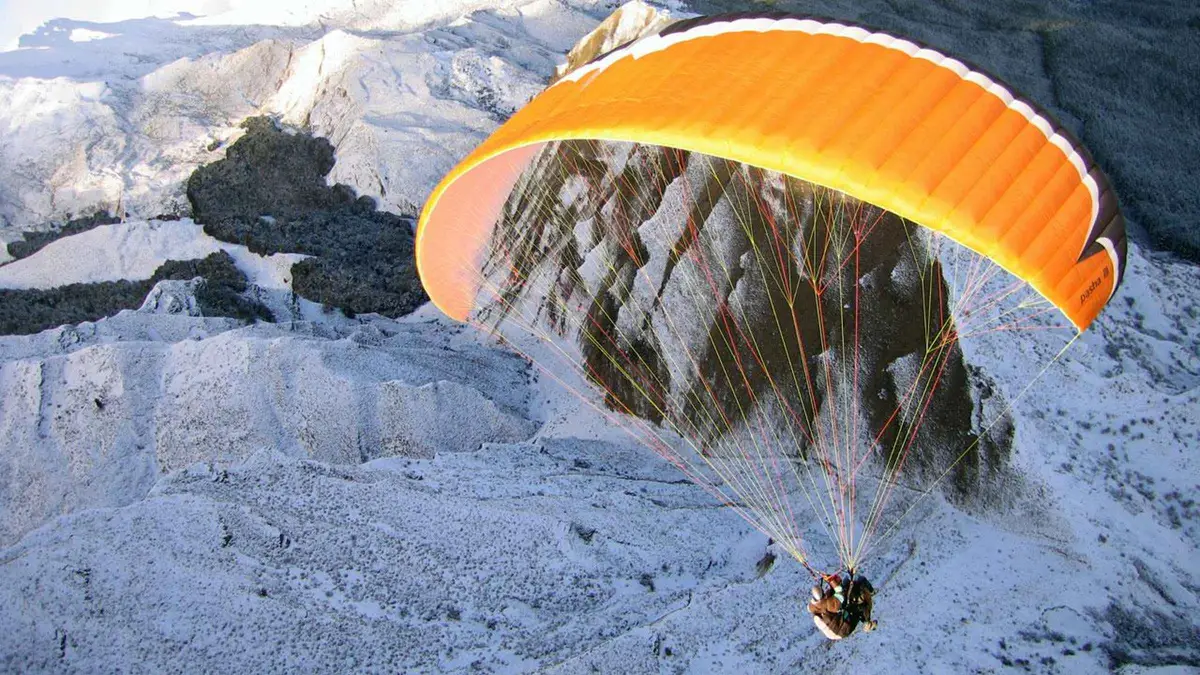
Queenstown: Tandem Paraglide - Winter - Coronet Peak 5400ft
The winter flight, launched from 5,400 feet, the highest commercial site in New Zealand, which buys the longest time in the air. A ski-field pass is needed to reach take-off and can be bought at check-in.
Check Availability from $289.74
Queenstown Helicopter Flight with Snow Landing | 30 mins
Thirty minutes with an alpine snow landing, pitched at families and first-time flyers, flying from the Heliworks base at Frankton. Hotel pickup is an option rather than standard, so check what you booked.
Check Availability from $186.72
From Queenstown: Cardrona First Timer Ski or Snowboard
A learn-to-ski or snowboard day at Cardrona with the transfer from Queenstown, the skis or board, the outerwear, the learner pass and a full day of group lessons in one booking. Nothing to hire on arrival.
Check AvailabilityPrices, ratings and details are the platform's own, checked in Q3 2026; dollar figures are the listed prices — the platform bills in your account's currency.
The Mountain New Zealand Learned to Ski On
The numbers below are NZSki's own, from its 2026 winter media kit for this field.
Coronet Peak opened in 1947 and NZSki still calls it the country's first commercial ski area. It is not the biggest field in the region. What it has is proximity: 16 kilometres of sealed road from town, about 20 minutes, close enough to ski a half day and be back for an early dinner.
The peak stands at 1,649 metres with a vertical drop of 462 metres over 280 hectares. Average annual snowfall is 1.99 metres before any snowmaking, and that last clause matters here, because the natural figure is modest and the machinery is not.
The lifts and the snow guns
The lift network is a high-speed six-seat chair, a second high-speed six-seater carrying gondola cabins as well as chairs, a high-speed quad, a T-bar and four surface conveyors for beginners. That is a short list by North American or Alpine standards and a long one for New Zealand.
Snowmaking is where the field puts its money: 229 fixed guns plus three portable units, which NZSki describes as the most extensive setup in the Southern Hemisphere. New for 2026 is a Snow Factory, which the operator calls a South Island first and says makes snow in all weather, 'even at 20°C'. That machine is the reason the 2026 season was targeted to open on 29 May, with a 'winter made early' window from 29 May to 12 June running on manufactured snow.
Where the season dates disagree
NZSki's own media kit gives 29 May as the targeted opening and 4 October as the anticipated close. Destination Queenstown, the regional tourism organisation, lists 13 June to 4 October for the same field. Both were readable on in Q3 2026 and neither is wrong: the earlier date depends on the new snow factory delivering, which is why the operator writes 'targeted' rather than 'opens'.
Book flights around the middle date and treat late May as a bonus. If you are choosing months rather than dates, the best time to visit page sets the ski season against everything else Queenstown does.
How Much Time to Give Coronet Peak
Three routings, with door-to-door times measured from central Queenstown using the operator's own 20-minute drive figure and its published mountain hours. What each one skips is the point of the table.
The mountain is close enough to be a half-day, which is unusual and is the main practical reason to choose it over anything further out. The trade is that the terrain is finite: strong skiers who ski all season find the trail map small by the third day.
| Routing | Door to door | Pass | What it skips |
|---|---|---|---|
| Afternoon only | About 5 hours from town, 12:30 to 16:00 on snow | $78.80 (NZ$135) afternoon | The groomed morning, and any hope of a lesson slot |
| Full ski day | About 8 hours, 09:00 to 16:00 on snow | $105.10 (NZ$180) Superpass | Nothing on the mountain; it costs you the rest of the day in town |
| Full day plus Night Ski | About 13 hours, 09:00 to 21:00 with a break | Day pass plus the night pass, price not published | Dinner in town, and a Wednesday or Friday elsewhere in the trip |
A non-skier's visit is a different shape again: in summer a half-day drive-and-look, in winter the base building, the view and lunch, with no lift pass needed to be there.
The Road, the Bus and the Chains
Access figures from NZSki's media kit and the Queenstown Lakes District Council winter maintenance service levels document, both read on in Q3 2026.
Coronet Peak Road climbs off Malaghans Road north of Arthurs Point and is sealed the whole way, which is not true of every field in this region. The council classes Skippers and Coronet Peak Road as a Priority 1 winter road, meaning it is gritted when necessary between 07:00 and 22:00 and that snow clearance starts here 'ahead of all others'. That is the strongest single argument for this mountain over the alternatives on a bad-weather morning.
Sealed and prioritised does not mean chain-free: a two-wheel-drive rental on summer tyres is the vehicle that ends up parked on the verge. Carry chains, and read the snow report first, which NZSki updates daily by 06:30.
| Way up | What it costs | Time | The catch |
|---|---|---|---|
| Own car or rental | Fuel only; parking is at the base | About 20 minutes, 16 km | Chains may be required; the upper car parks fill in the school holidays |
| NZSki ski bus | $21.00 (NZ$36) return | Runs through the day from the centre of Queenstown | Stop names and a timetable are not published on any page we could read |
| Night Ski bus | Not published separately | A dedicated evening service on night-ski days | Only on the nights the mountain runs the lights |
| Orbus public bus | Not applicable | No route serves the ski field | Orbus is a town network; the ski bus is the operator's own |
What we could not find out about the bus
NZSki publishes the fare and the phrase 'from the centre of Queenstown' and nothing else: no stop list, no departure time, no last bus down, and the transport page on nzski.com returns a 404. Ask at the operator's town office the night before, and do not build a tight return connection around a timetable that is not public. The town network is a separate thing, on the getting around Queenstown page.
Night Ski: the Dates Are Published, the Price Is Not
This is the field's genuine point of difference. NZSki runs the lights from 16:00 to 21:00 on Wednesday and Friday nights from 1 July to 4 September, with two extra Saturday sessions on 11 and 18 July in the school holidays, and it markets the operation as New Zealand's only night skiing.
What the operator does not do is print a standalone adult price for it on the lift-pass page. The Night Ski Pass exists there as a product and appears again inside a student three-day-plus-night pass, but the figure is behind the booking flow. A separate reading of NZSki's own shop on the same day returned a different structure again, and rather than publish a number two of the operator's own pages do not agree on, we print none. Price it at the checkout, and treat any night-ski figure you find on a third-party site as unverified.
What a night session is actually like to plan
The lit terrain is a fraction of the daytime map and the temperature drops hard once the sun leaves the ridge. The one operational fact worth knowing is that a day pass scanned late in the afternoon can carry through to the evening on operating nights, which turns a slow weather morning into a long evening instead. If the party is split between skiers and non-skiers the evening works better than the day, and the things to do in Queenstown hub has what the others can do with the afternoon.
Coronet Peak Is Open in Summer, and Almost No Guide Says So
Half the internet writes that the Queenstown fields shut when the snow goes. NZSki's own 2026 media kit says the opposite for this one: 'summer operations include sightseeing, with the Peak Gondola and chairlift accessed mountain bike trails'. Those are the operator's words, and they describe a lift-served mountain in January.
What the media kit does not carry is a summer opening date, a summer closing date or a summer price. We looked for all three and found none on any page that answered, which is why this section names the operation and not a fare. If you are planning a summer drive up, phone the field or check the site in the week you travel rather than budgeting from anything printed here.
Why it matters for a summer trip
A summer visitor with a car and a spare morning has a sealed road to 1,649 metres, a chairlift, a view over the Wakatipu basin and a bike network at the top, for a fraction of what the helicopter alternatives cost. It is not a walking mountain in the way Ben Lomond or Queenstown Hill are; the trails up here are built for bikes, and the Queenstown walks hub is the place to start if the plan is boots.
The 2026 Season, in the Operator's Own Dates
Every date NZSki publishes for this field in one column, so a trip can be planned around the windows rather than around the season as a block.
-
1947
The first commercial ski area in New Zealand opens
NZSki still uses the phrase in its media kit; the field predates every other commercial operation in the country.
-
29 May 2026
Targeted opening, the earliest here
The word in the media kit is 'targeted', not 'opens'. It depends on the new snow factory.
-
29 May to 12 June 2026
The 'winter made early' window
Machine-made snow only, on a limited footprint, using the snow factory NZSki calls a South Island first.
-
13 June 2026
The date the regional tourism body lists as the opening
Destination Queenstown publishes 13 June to 4 October for this field. Plan on this one and treat late May as a bonus.
-
29 June to 20 September 2026
First Tracks runs
An 08:00 start on fresh grooming, sold with the day pass at $140.20 (NZ$240). Grooming itself starts at 08:00 daily through the season.
-
1 July to 4 September 2026
Night Ski, Wednesday and Friday nights
16:00 to 21:00. NZSki markets it as New Zealand's only night skiing.
-
11 and 18 July 2026
Two extra Saturday night sessions
Added for the school holidays. No other Saturday is listed.
-
1 September 2026
Spring pass rates begin
Five days for $306.60 (NZ$525), which is $61.30 (NZ$105) a day, the cheapest adult day rate NZSki publishes here. The Spring Shred Challenge ran from this date.
-
4 October 2026
Anticipated close
The operator's word again is 'anticipated'. A warm September shortens it.
-
Summer 2026 to 2027
Sightseeing, the Peak Gondola and bike trails
Confirmed as an operation in the media kit; no dates, hours or prices are published for it.
Dates from NZSki's 2026 winter media kit for Coronet Peak and its lift-pass and night-ski pages, plus Destination Queenstown's season listing, all read on in Q3 2026.
Coronet Peak: What to Do and What Not To
Each of these is argued somewhere above; this is the version you can act on the morning of.
Do
- Read the snow report before you leave town. NZSki updates it daily by 06:30, and it is the difference between a drive and a wasted morning.
- Carry chains even on a clear day in town. The road is sealed and gritted first, which is not the same as clear.
- Buy the afternoon pass if you will not be on snow by noon; it is $26.30 less than the full day for the half you were going to ski anyway.
- Take the ski bus at $21.00 (NZ$36) return if there are two of you and one wants a beer at the top.
- Move the trip into September if the budget is tight: the spring rate is $61.30 (NZ$105) a day on a five-day pass.
Don't
- Do not budget a child's day from anything you read online. NZSki publishes no child rate on any public pass page, ours included.
- Do not plan a Saturday night session outside 11 and 18 July; the lights run on Wednesdays and Fridays otherwise.
- Do not assume a 'from' price you saw on a summary page is the walk-up rate. The published walk-up adult figure is $105.10 (NZ$180).
- Do not treat the ski bus as a scheduled service you can time a return flight around; no timetable is published.
- Do not book a Coronet Peak paraglide expecting the flight alone to get you to the launch; a lift pass is required on top of it.
Five Things Most Visitors Do Not Know About Coronet Peak
- The mountain runs in summer as well as winter, with sightseeing, the Peak Gondola and chairlift-served bike trails, though no summer dates or prices are published (NZSki 2026 winter media kit for Coronet Peak).
- The day pass is not a Coronet Peak ticket: it is the Superpass, valid at this field, the ski area across the valley, Mt Hutt and nine more New Zealand fields, with the per-day rate falling as days are added (coronetpeak.co.nz lift-pass page).
- No child, youth or senior day rate is printed on any public NZSki pass page for this mountain; the figure only appears once you are inside the booking flow (coronetpeak.co.nz and the NZSki shop, read on in Q3 2026).
- The night-ski price is not published as a standalone figure either, which makes an evening session the one product here you cannot budget before checkout (coronetpeak.co.nz night-ski page).
- The council clears this road before any other in the district: Skippers and Coronet Peak Road are Priority 1, gritted between 07:00 and 22:00, with snow clearance starting here ahead of all others (QLDC winter maintenance service levels).
- The tandem paraglide that launches from the summit needs a lift pass of its own to reach the take-off, quoted at about NZ$35 at check-in for anyone without one (the operator's GetYourGuide listing, a winter 2024 figure).
What a Closed Day Actually Means for Your Booking
Coronet Peak does not close because it is full. It closes because the wind stops the chairs, because the road cannot be opened, or because rain has taken the snow off the lower runs.
A lift pass is bought for a day and it is the operator's terms, not ours, that decide what happens to an unused one. Read them at the checkout, because they differ between the day pass, the multi-day passes and the spring pass.
- A weather day is not a slot you can move at the gate. The decision is the operator's and it is made on the mountain, not in town.
- The two booked products on this page do publish a rule: both the tandem paraglide and the beginner ski day carry free cancellation up to 24 hours before the start time, which is a firmer promise than the lift pass gives you.
- The helicopter alternative is explicitly weather-dependent: cloud, wind or an alpine landing site out of limits moves or cancels the flight, and the operator rebooks or refunds under its own terms.
- Nobody in this valley publishes a wind speed or a visibility figure at which they stop. We looked. The trigger is stated as operational judgement on every page we read, which means the snow report at 06:30 is the only forecast that counts.
If the mountain is shut
The town has a wet-weather layer that has nothing to do with snow, and it is worth having chosen it in advance rather than at 08:00 in a car park. Start with the rainy day options, and if the whole week looks marginal, the Queenstown in winter page sets out what the season does when it is not skiing.
Coronet Peak on the Map
The field, the road it climbs and the two mountains a visitor confuses it with. Coordinates from the LINZ gazetteer entry for the Coronet Peak Recreation Reserve and for Double Cone.
The ski-area pin is the north-east corner of the LINZ bounding box for the recreation reserve; the reserve itself runs south and west of it. OpenStreetMap tiles.
What Else Is Up That Road
Three things within about 20 minutes of the bottom of Coronet Peak Road, with what each costs and how long it takes.
Arrowtown
The obvious pairing with a half-day on the mountain: an old gold town at the bottom of the same set of hills, and the place to eat after an afternoon pass. Arrowtown has the detail.
About 20 minutes by carSkippers Canyon
Skippers Road leaves from the Coronet Peak road and is a completely different proposition: unsealed, exposed and excluded by most rental agreements. Skippers Canyon explains why you take a tour rather than a rental car.
The turn-off is on the same roadThe range across the valley
The same Superpass, a higher mountain, more snow and a gravel access road. The Remarkables page sets out the difference before you choose a day.
45 minutes from town, the other directionCoronet Peak Questions
Can you drive up to Coronet Peak?
Yes. The access road is 16 kilometres of sealed road from Queenstown, about 20 minutes, and the council grits and clears it ahead of every other road in the district. Chains can still be required, and the alternative is the operator's ski bus at $21.00 (NZ$36) return, which is covered on getting around Queenstown.
Can you go to Coronet Peak and not ski?
Yes, in both seasons. In winter a non-skier can ride up on the bus or drive, use the base building and the view without a lift pass; in summer the field runs sightseeing, the Peak Gondola and bike trails. The tandem paraglide from the summit is the one non-skiing product booked online, and it needs a lift pass on top of the flight price.
How much is a day at Coronet Peak?
The published adult walk-up figure is $105.10 (NZ$180) for the full-day Superpass, $78.80 (NZ$135) from 12:30, $64.20 (NZ$110) for the learner area only and $61.30 a day (NZ$105) on a five-day spring pass from 1 September. Every option is in the pass table above.
How much does night skiing cost here?
The operator does not publish a standalone adult price for it. The Night Ski Pass is sold on the passes page and inside a student three-day-plus-night pass, but the figure appears at checkout, and two of NZSki's own pages did not agree on the day we read them, so we print none. The dates and hours are published: Wednesday and Friday 16:00 to 21:00, 1 July to 4 September, plus Saturday 11 and 18 July.
Is there a child price for Coronet Peak?
Not one that is published. Every public NZSki pass page prints 'per adult' and nothing else; a child figure only appears inside the booking flow. If you are pricing a family day, price it at the checkout, and be aware that the beginner day at the other resort is the only family ski product on this site with a fixed listed price.
When does Coronet Peak open and close?
NZSki targeted 29 May 2026 for opening and anticipates closing on 4 October, with a machine-made-snow window from 29 May to 12 June. Destination Queenstown lists the same season as 13 June to 4 October. Plan on the later date. The season in full is set out above.
Does the pass work on other mountains?
Yes, and that is the main argument for buying multiple days. The Superpass is valid at this field, at the ski area across the valley, at Mt Hutt and at nine further New Zealand fields, and the per-day rate falls as days are added. It does not cover Cardrona, which is sold separately by a different company.
Coronet Peak on Video
Three films that show the terrain, the base area and the learner conveyors better than any trail map. Watch the first if you are deciding whether the mountain is big enough for your week.
Coronet Peak Resort Guide | South Island | New Zealand
A run-by-run tour of the trail map, which is the fastest way to judge whether the terrain suits your level.
Video: MTNhacksAn Insider's Guide to Coronet Peak
The base area, the lift network and where the intermediate terrain actually sits.
Video: SRG SkiingLearn to Ski or Snowboard at Coronet Peak | Intro to Snow Package
The operator's own film of the learner area, useful if you are weighing the learner pass against a full lesson day.
Video: Coronet PeakVideos load from YouTube only when you press play. None of them is ours and none is sponsored.
Reviewed Q3 2026 (July–September 2026); next review Q4 2026. Prices, hours and terms are set by the venue or operator and confirmed at checkout.
We may earn a commission if you book through one of our links, at no extra cost to you. Full affiliate disclosure